Twin Life-and-Death Link Rule
A Werewolf Thing: A Rejected Mate Werewolf RomanceThe Twin Life-and-Death Link Rule is the supernatural principle governing Trevor and Saphira’s relationship: their connection extends beyond shared blood, and the death of either twin causes the death of the other. It transforms their bond from a family fact into a life-or-death condition, making every injury, disappearance, and rescue involving one twin consequential for both.
Definition and Operation
Trevor describes Saphira as his twin and insists that they possess “a connection beyond just blood.” The rule is not presented as ordinary emotional closeness or biological kinship. It is a binding connection with a direct physical consequence: if one twin dies, the other dies as well. The narrative therefore treats the twins as two separate bodies joined by a single fatal vulnerability.
The rule also explains why Trevor can respond to Saphira’s disappearance through faery magic. Trevor says that faeries can perform a ritual to search for one of their own, but that only full faeries have previously performed it. Because he is not fully faery, using the ritual is uncertain and dangerous rather than routine. The search drains energy and power, and if it continues too long, it may cause death. The twins’ connection thus creates both an imperative to act and a limit on the means available to them.
Dramatic Activation
The rule becomes decisive when Saphira is missing and the group considers how to find her. Trevor does not treat the search as optional. He argues that his connection with Saphira qualifies him to attempt the faery search ritual, even though the ritual has traditionally been performed only by full faeries and may kill its practitioner. His willingness to risk his own life follows directly from the rule: refusing to act leaves Saphira in danger, while acting exposes Trevor to a separate but related danger.
The revelation also changes the meaning of Saphira’s earlier poisoning. After an arrow strikes her, a doctor states that the arrow was coated in poison. The injury is therefore more than an isolated attack on Saphira; under the Twin Life-and-Death Link Rule, any lethal outcome would also threaten Trevor. The rule magnifies violence against one twin into a threat against the pair, widening the consequences of a single weapon and making medical information immediately urgent.
Protection, Risk, and Care
The same logic appears when Trevor warns Saphira not to fight because she is pregnant. His concern places her body at the intersection of several obligations: she is an individual at risk, a pregnant mother, a combatant facing an army, and one half of a pair whose death would destroy the other. Saphira rejects the idea that pregnancy makes her incapable of leadership, answering that her half-faery nature allows her to cast a protective charm on herself. The exchange shows that the rule does not eliminate Saphira’s agency; instead, it intensifies the conflict between Trevor’s protective judgment and Saphira’s determination to act.
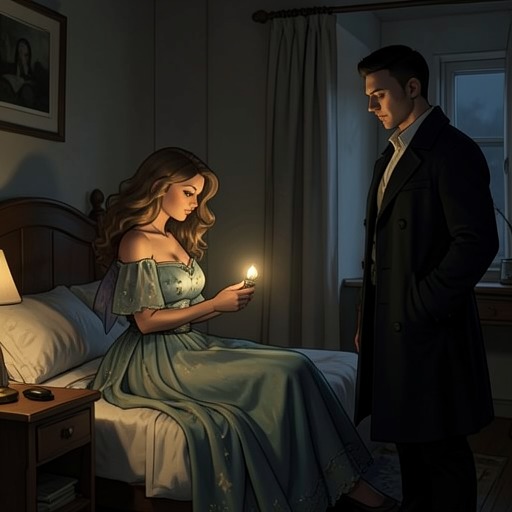
Care surrounding Trevor is likewise shaped by the severity of his condition. When he lies limp, pale, sweaty, and apparently struggling to wake, Saphira has to beg Carmen for more than five minutes before Carmen allows her an hour alone with him. Carmen has not slept since Trevor arrived and has barely been eating, suggesting that his condition has exhausted those caring for him. The rule gives this bedside scene an additional dimension: Trevor’s suffering cannot be contained within his body, because his death would also mean Saphira’s death.
Narrative Significance
The rule makes kinship a form of shared embodiment. Trevor and Saphira remain distinct people with different choices, bodies, and powers, yet the story refuses to let their fates become fully separate. Their bond creates a recurring contrast between individual freedom and relational responsibility: Saphira may choose to fight, and Trevor may choose to attempt a lethal ritual, but neither choice can be understood without the other twin’s survival.
It also gives sacrifice a precise magical cost. Trevor’s search ritual is not simply heroic effort; it is an act that may consume his energy and power to the point of death. Because the twins are mutually bound, that sacrifice threatens to become self-defeating: a failed or prolonged rescue could kill Trevor and, through the same rule, Saphira. The rule therefore prevents the connection from functioning as an effortless tracking device or sentimental symbol. It is a power defined by limitation, risk, and consequence.
The bond remains emotionally visible even when its supernatural mechanics recede. After Ashton approaches Saphira, she moves toward him and throws herself into his arms; he holds her carefully around her stomach and tells her that he missed her. That reunion foregrounds Saphira’s romantic and family life, while the Twin Life-and-Death Link Rule supplies the deeper structural reminder that her survival is also Trevor’s survival. The story’s attachments consequently overlap rather than replace one another: romantic protection, pregnancy, sibling connection, magical inheritance, and bodily danger all converge around Saphira’s continued life.